The Nets’ Midterm Grades Are In

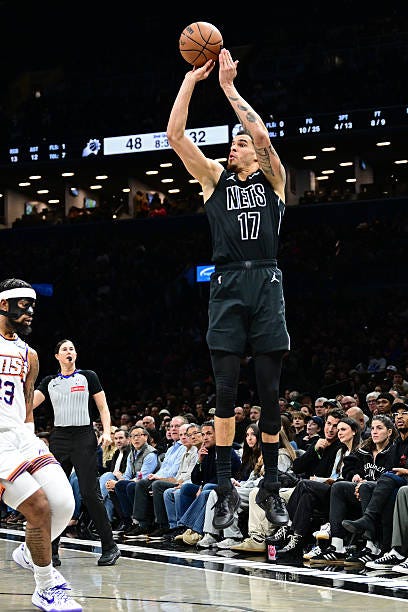
Grade inflation is a foreign concept for those who grew up in my generation, so that’s why I typically aspire to evaluate things as they are, with little regard for extenuating circumstances.
The Nets, who dropped to 12-29 at the season’s midpoint with Monday night’s 126-117 loss to visiting Phoenix, are a bad basketball team. Hence, the values below I ascribe to players for their performances to date will reflect that. I’m not going to give them passes because, for example, they’re inexperienced or playing out of position. I’ll make note of such caveats in the analysis, but my grades do not reflect what the player could be (the so-called “potential”) but rather how well they have been doing it.
Obviously, midterm grades aren’t final. There will be plenty of opportunities for players to show improvement and make up for deficient metrics. With the Nets sporting the league’s youngest roster, it would be horrifying if certain ones didn’t.
Here then are the Nets’ first half grades, with one defining stat highlighted (all stats per NBA.com through Sunday’s Game 40 loss in Chicago):
Michael Porter Jr.: A-minus
Porter had missed a combined six regular season games over the last two seasons for Denver. The Nets, obviously incentivized to minimize winning in 2025-26, have already held him out of eight games. The difference when he does and doesn’t play has been stark. Not only has Brooklyn lost all eight of those load managed affairs, five of those defeats were by more than 15 points. Of Porter’s 33 games, six resulted in routs by such a margin, with three of them occurring within the first seven games when the team struggled in functioning with the Porter/Cam Thomas dynamic. The Nets have produced their most efficient offense (116 points per 100 possessions) when Porter is on the court and their least efficient (103.4 rating) when he’s off. He’s been more than simply a prolific shotmaker; he’s passing and rebounding at career high rates. The “minus” is for the indifferent defense he showed in the early going. It’s not great now, but he’s improving in the “stocks” categories, averaging 1.6 over his last 20 games. He’s deserving of All-Star honors (See: The All-Star Case For Nets MPJ - by Steve Lichtenstein). Enjoy him, Nets fans, while you still can.
Day’Ron Sharpe: B-plus
The guy has a knack for helping his team win his minutes. As I mentioned in a prior post (Will Hard-Working Sharpe Be One Of Marks’ “Next Nets”?), Sharpe is on track to lead Brooklyn in net rating for a third consecutive season. When you consider all the roster turnover and gaggle of different teammates to which he’s had to adjust, that’s quite the feat. His size and skill are not adequate to excel as a starting NBA center, but as a backup, he’ll give you energy, most proficiently on the offensive glass, and a good feel for the game on both ends. It’s why he’s often mentioned in trade speculation, though for consideration well below premium value.
Nic Claxton: B
Nets Head Coach Jordi Fernandez has attempted to reinvent Claxton in the model of big man Domantas Sabonis, whom Fernandez coached as a Sacramento assistant. In Brooklyn’s offense, Claxton operates from the top of the key as a hub for actions like backdoor cuts and dribble handoffs. Given the opportunity, he’ll drive to the basket. Claxton leads Brooklyn with 4.1 assists per game, nearly double his prior career high without a corresponding increase in his turnover rate. He’s also converting a best ever 64.6% of his free throws. Though his blocks (1.4 per game) are down from his league leaderboard levels of a few years ago, Claxton remains an elite rim protector—he is third behind Minnesota’s Rudy Gobert and Oklahoma City’s Chet Holmgren in NBA.com’s field goal percentage differential as the nearest defender on opponent shots from within six feet. On the downside, his rebounding efforts have wavered and he’s 40-for-100 (40%) on paint shots outside the restricted area—only New Orleans rookie Derek Queen and Cleveland’s Evan Mobley have been worse among the league’s 19 centers with at least 100 such field goal attempts. As valuable as Claxton has been for Brooklyn over his six-plus seasons, where would he rank among the league starting centers? Is he even in the top 50 percent? I think a grade a little above average is fair.
Egor Demin: B-minus
Ok, here goes the first of Brooklyn’s five rookies, Demin being one of four who were 19 on Draft Day. A three-point rate a couple of ticks below 40% is fantastic, especially from a guy who threw up bricks (27.3%) from the shorter college distance at BYU last season. The rest of Demin’s game, though, remains underdeveloped. He is just not yet ready physically, pushed around on both ends to the point where Fernandez has had to pull him off the court a few times. He averages 0.5 paint touches per game, a very low number for a point guard, according to NBA.com’s tracking (I can’t vouch for its accuracy, but the eye test and his 1 free throw attempt per game affirm the point). As a result, we haven’t seen enough of the next level passes referenced in the hyped pre-Draft scouting reports. Overall, though, Demin’s youth and length make him an intriguing prospect, and the early three-point success is indeed a major windfall.
Drake Powell: B-minus
The beauty of this irrelevant Nets season is that the rookies have the freedom to make some mistakes. If only Powell would make use of that freedom more often. His athleticism is off the charts and his base basketball fundamentals are workable. So what if his handle isn’t the tightest or he is more efficient with a shot diet leaning more towards inside the three-point arc (he’s 8th in the league among the 177 players with at least 15 midrange attempts with a 58.8% rate). Whether this needs to be said to Fernandez or Powell’s own conscience: Let him cook. (See: Drake Powell Versus Nets’ Math Department.) That plea for additional aggressiveness also applies to the defensive end—with his quick feet and 7-foot wingspan, Powell can be Brooklyn’s version of Atlanta’s havoc-wreaker Dyson Daniels. As it is, Powell, who was hampered by ankle woes during the first few months, has been fine, good enough to earn a starting role despite a three-point efficiency that has plummeted to 30.9%. I eagerly await his progress over the season’s second half.
Danny Wolf: C-plus
Fernandez has seemingly played Wolf, a lumbering 6-foot 11 rookie, everywhere but the center spot he manned in college, other than in rare circumstances like garbage time. Perhaps it’s because Wolf doesn’t possess Fernandez’s rim protecting prerequisite for the position. Or maybe Fernandez thinks he can weaponize Wolf’s rather unique ball skills at other spots, thereby helping the lineup’s size matchups. Nevertheless, Wolf has endeared himself to Fernandez through his efforts in staying in front of quicker ballhandlers and willingness to hoist from deep, where he has knocked down 35.7% of his attempts. Wolf will turn 22 in May, which implies he has less “upside” than his rookie cohorts. Still, I expect he will improve on things like his lefthanded finishes and turnover rate with experience.
Noah Clowney: C
No Net has had a more overrated first half than Clowney, a 2023 first round pick (No. 21 overall). At 21, he is actually two months younger than Wolf. For some reason, Fernandez often has had Clowney act as the primary (pre-switch) defender on opponents’ lead scorers. The results have not gone well. Last month, an NBA data analyst tweeted about the players who had been blown by the most—I expected Demin in the league’s top 10; I did not expect to see Clowney. But there he was, worse than Demin. Opponents have also shot nearly 5% better than their averages from those distances with Clowney as the nearest defender. As for Clowney’s own shooting, it has taken a deep dive, all the way down to a 38.6/31.7/79.4 split. It’s been nice to see him drive closeouts, but his 56.2% finish rate inside the restricted area ranks 117th (a tad better than Wolf) among the league’s 123 forwards with at least 70 such attempts. I had hoped for better from a 6-foot 10 player with his hops in his third season. Among the positives: Clowney has clearly improved his awareness in help defense and versus opponents’ transition opportunities and his shot does not appear to be broken, which could portend another hot streak following a much-needed All-Star break.
Ziaire Williams: C
The “C” is for a lack of consistency, both in effort and efficiency. Fernandez expected more from the long former top 10 Draft pick by Memphis; it’s why Williams has been a DNP-CD a few times this season. Williams leads the Nets in deflections and is second (behind Sharpe, of all people) in steals per 36 minutes. It leaves Fernandez wanting more on that end. At 6-foot 9, his 8.3% defensive rebounding rate, the 14th-lowest among the league’s 150 forwards who played at least 25 games this season, is disturbing. Offensively, the left corner 3 continues to bedevil Williams—he’s 4-for-26 (15.4%) from there and 42-for-121 (34.7%) from other three-point areas. He’s even in 13th place among the league’s 154 forwards with a 68.8% conversion rate from inside eight feet (45 shot minimum). At 24, Williams doesn’t have as much time as many of his teammates to prove himself a keeper for the long term.
Nolan Traore: C-minus
Here’s an example of a young player battling back from a really rough start to his NBA career. Traore, a 19-year old French point guard, struggled with the simple task of bringing the ball into the frontcourt. A six-week tuneup in the G League helped restore his confidence. While his numbers remain substandard, you could see the progress in everything from his drive-and-kicks to his finishes around the basket and from behind the three-point line. In his last six games, Traore is averaging 6.6 assists to 2.4 turnovers per 36 minutes. (See: Nets Rookie Learning To Harness Superpower.) Like Powell, Traore has certain athletic gifts, like speed, that can’t be taught. His development may take longer, but it’s worth monitoring.
Terance Mann: C-minus
Ah, the law of diminishing returns. Mann opened the season competently, shooting 45.4% from the floor, including 36.5% on three-pointers, in his first 18 games. He’s shooting at a 43.8/28.2 clip in the 18 games since and has ceded the starting 2 guard job to Powell. Mann hasn’t had the defensive impact I had hoped for either as measured by NBA.com metrics. The Nets chose to house his approximately $16 million AAV through 2028 on their books because it got them the pick they used for Powell. Mann, a 29-year old Brooklyn native, is allegedly embracing his role as the team’s elder statesman. However, you’d think he’ll someday be included in a major trade whenever the Nets feel ready to take the next step.
Jalen Wilson: C-minus
There are no “E” for effort grades here, unfortunately. Wilson, who is already 25 though, like Clowney, a 2023 Draft pick (No. 51 overall), has been the epitome of the professional role player. He’ll go a week getting up from the bench solely to cheer for his teammates on the sidelines and then he’ll be ready for action when Fernandez wants to, A) send a message to underperforming rotation members, or B) wave the white flag. He’s just not good enough, especially when Fernandez slots him at the 4. For a 6-foot 6 guy who plays below the rim, many defensive reps where he is forced to rotate as a low man have been cringeworthy. That happens a lot with tweeners, who are also too slow to hang with the better ballhandlers on the perimeter. While Wilson’s three-point shooting (36%) is slightly above league average, he is known to be streaky, so a regression to his mean is possible if he gets more run because the Nets have opted to go all in on the tank with trades/buyouts. In addition, seven of Wilson’s 39 paint shots have been blocked. That seems like a lot. The kindest way to put it is that he’s not a bad guy to keep as a team’s 13th player.
Tyrese Martin: C-minus
Fernandez adores Martin’s toughness, but he’s simply too slow for what he’s asked to do. He’s had two games where he combined to drain 10-of-16 three pointers; take those away and he’s 38-for-121 (31.4%) on the season, an unacceptable rate for a 26-year old auditioning for playing time in Brooklyn or elsewhere around the league. The inconsistency spreads to all aspects of his game—his penetrations have created some good looks for himself and teammates, but he’s also prone to live-ball turnovers. I do commend his willingness to stick his nose underneath to snare rebounds, which has been a problem area for the team all season. Overall, he’s a lot like Wilson—a guy who will always give you effort and can put up some noteworthy numbers on occasion but not someone who can produce enough to deserve rotation status.
Cam Thomas: C-minus
I’ll cop to this grade being overly generous, since the Nets’ best stretch of ball in the season’s first half came when Thomas was out with his recurring hamstring problem. I think it’s ok to have some sympathy for this homegrown player over his in limbo situation going forward, though it’s largely of his own making. Brooklyn is 3-14 when he has played, not counting the game in Indiana where he exited after 5:35 of action. Taking “volume scorer” to new heights, Thomas has shot above 50% from the floor in just two of those games. Showing he can pass, he registered 10 assists during Sunday’s loss in Chicago and 9 in the season opener versus Cleveland; he exceeded four assists just one other time in between, implying he chooses not to. With regard to his defense, Thomas might simply be a lost cause. Fernandez is sticking with his “minutes restriction” story as to why Thomas has been moved out of the starting lineup to a sixth man role. The more probable reality is that the Nets and Thomas do not have a future. After signing a $6 million qualifying offer while a restricted free agent, Thomas can’t be dealt without his permission, and it’s not like other teams are banging down the Nets’ door to make offers anyway, at least according to NBA insiders. I can see Brooklyn waiving him if he can’t be traded by the February 5 deadline.
Ben Saraf: D
Since he’s only 19, it’s too soon to call this a wasted pick, especially when it was at No. 26 overall. But I can see it trending in that direction. Unlike Traore, Saraf’s G League experiences have been wrought with ups-and-downs. He was 3-for-his-last-14 (21.4%) from three-point territories over his last five games for Long Island before Monday’s 3-for-6 outing. No matter how well he physically employs his body to score when he gets into the paint, he can’t be effective in The Show until that shot is fixed. Defensively, he was a mess during his 12 Brooklyn games (that Fernandez gave him five starts early in the season was mind-blowing), targeted unmercifully by opponents who freely went around or through him in one-on-one reps.
Haywood Highsmith: Incomplete
Nothing fishy about holding him out as he continues his rehab from meniscus surgery, right? Apparently, he’s a player whisperer in street clothes.
What grade would you give Jordi Fernandez? I say a solid B because he's still getting more out of this group than expected, but his (questionable) lineup decisions piss me off sometimes, specifically playing Wolf at anything but Center. Let's also remember he played small-ball to begin the season with MPJ as a 4 and Clowney as a reserve