Nets’ Double Teams Unlocking Triple Threats

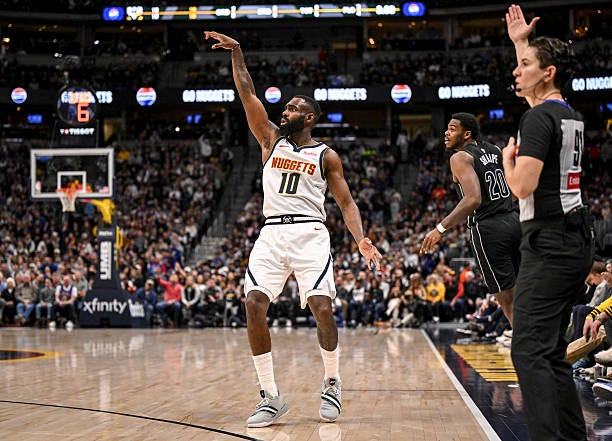
With a little under four minutes remaining in the third quarter of Thursday night’s 107-103 Nets loss in Denver, Brooklyn’s borderline backup guard Tyrese Martin left his man to double team the Nuggets’ star guard Jamal Murray on the perimeter. The problem was that Martin’s man was Tim Hardaway Jr., who had already made five of his six three-point attempts that evening.
The next sound you heard was the few dozen Nets fans still up at that late hour to watch this team collectively smack their foreheads. What are we doing?
The Nets, who valiantly battled back from a 15-point halftime deficit to tie the game at 70-all, trailed again. And though Brooklyn might have stolen it had Michael Porter Jr., who was magnificent with a 38-point/10-rebound double-double in his return to the arena where he toiled for seven seasons and won a Championship prior to last summer’s trade to Brooklyn, made a couple of uncontested shots down the stretch, a main source of this defeat was easily observable.
Denver shot 13-for-26 from deep on Thursday, the third time in the Nets’ last six games their opponent’s three-point field goal percentage hit at least 50%. Not 40%, which is considered a bad day for a defense. 50%.
The overwhelming majority of those shots, according to NBA.com’s tracking, were wide open, with a distance of six feet or more to the nearest Nets defender. And many of those (from my eye test only—I do not have data on this) were the windfalls from Brooklyn’s double teams, which cause the other defenders to scramble in rotation until the inevitable free look is found.
The double team tactic to get the ball out of a star players’ hands is a way for a coach to say, “Let others beat us.” Well, Jordi Fernandez’s Nets have been beaten. And beaten. And beaten some more. Brooklyn (12-34, tied for the fewest wins in the league this season—rejoice, pro tankers!) has lost seven in a row and are 2-14 in January with a back-to-back on Friday night at Utah in which Porter, their only reliable scorer, will almost certainly be load managed to close out the month’s slate.
Perhaps Fernandez got a little cocky from his 7-4 December during which Nets opponents shot 32.8% from three-point distances, the third-stingiest rate in the league in that span. He might not have accounted for the schedule, which saw Brooklyn play just 11 games, the fewest in the league, in those 31 days. I’d gather that probably helped keep his team relatively fresh. Facing some tanking and injury-depleted opponents was likely an additional factor.
In the long run, however, the disrespected lesser players left open by Brooklyn are still NBA players, and while many may dismiss the notion of a “hot-hand theory”, there is something to be said for finding a groove from seeing balls go through the net, even from players who would otherwise be labelled as bricklayers. Per NBA.com, the Nets’ 50.5% defensive field goal percentage in January, the worst in the league, is 3.4% higher than what those opposing shooters average from the aggregate distances. Only Orlando has yielded a higher differential this month.
If the Nets came with hard doubles in a turnover-forcing mission, that would be another matter. But Brooklyn is merely 23rd in the league in that category this month and 18th in steals. They’re just as likely to surrender offensive rebounds (they’re 23rd in defensive rebounding percentage) and second chance points (19th most). The opponent three-point percentage spike has been the death knell.
I just don’t get why the Nets can’t simply play straight-up help defense. They often switch unnecessarily miles from the basket, creating a mismatch that induces a double team. And there are many other instances where they can have the screener’s man show and recover instead of initiating the soft doubles that can easily be picked apart to generate a 4-on-3. If a smaller Nets defender gets stuck in the paint with an opposing big, yeah, you send an extra body. Otherwise, work through screens to get back in front of your man and rely on help if you get beat off the dribble.
The general rule has been that the more this team can keep their bigs adjacent to the paint, the better they defend and rebound. Having center Nic Claxton, who can be extremely effective in containing lead guards one-on-one, chase and scramble because he engages in a double team neuters his rim protection ability.
The Nets do have some lousy individual defenders—Porter, Cam Thomas, and Ben Saraf, to name a few—but many teams have found ways to shield those types of players without upending their entire defensive structure. The Knicks play top-notch D when needed with Jalen Brunson and Karl-Anthony Towns each averaging over 30 minutes per game.
In other words, Fernandez can find a better way than doubling down on double teams.