Devils Address Finishing Deficiency With Bet On Big Man(tha)

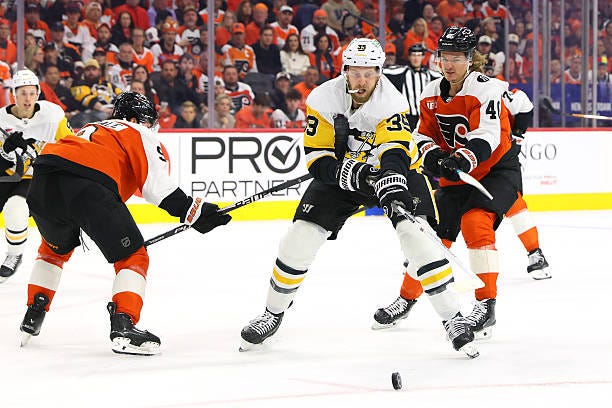
Given the paucity of high-end skill in the free agent market this offseason, the Devils’ signing of left wing Anthony Mantha to a 2-year, $9.5 million contract on Wednesday shouldn’t be judged too harshly.
Yes, the $4.75 million AAV consumed more than half of New Jersey’s available salary cap space for a player who, despite producing career highs in goals (33) and assists (31) by healthy margins in Pittsburgh last season, hasn’t exactly performed like an overachiever in his 11 NHL seasons following his first-round selection (No. 20 overall) in the 2013 Draft. Despite his 6-foot 5, 240-pound frame, Mantha generally shies away from the consistent physical play necessary in a middle six role—his 2.53 hits per 60 last season ranked 239th among the league’s forwards who played at least 50 games, per NHL.com. Diminutive Devils wing Jesper Bratt took the body more often.
However, one could make a case that Mantha would fare well playing alongside Jack Hughes and Bratt on New Jersey’s top scoring line, even if Mantha’s shooting percentage is bound for a regression (his 14.7 goals above expected were the league’s third-most last season, according to moneypuck.com). Mantha excels at getting to the net front, even at 5-on-5. NaturalStatTrick.com had him with 65 high danger scoring chances in such situations, which ranked 87th in the league last season, tied with San Jose star Macklin Celebrini. Considering how much difficulty the Devils had in finishing golden scoring opportunities, especially with the dynamic pair of Hughes and Bratt on the ice, Mantha might seem like a gift from above.
Mantha moves fairly well for a big man—NHL Edge tracking registered his speed in the top 75th percentile for his position. That’s around the same range as Devils wing Timo Meier, who is being paid an AAV of $8.8 million and hasn’t topped 30 goals since 2021-22, his last full season in San Jose. Keeping up with the pace set by more electric linemates shouldn’t be the main problem with Mantha’s addition to this potential configuration.
If you’re worried about Mantha’s disappearing acts in the playoffs, how about the Devils getting there first? They’ve missed out on six of the last eight postseasons, including two of the last three. Mantha hasn’t lit the lamp and notched only seven assists, but his playoff career sample is only 20 games. If Mantha’s presence can allow New Jersey to better distribute their scoring across at least three lines, then I like their chances to break through the Eastern Conference’s logjam. That has to happen this season.
Of course, the open question is whether Mantha could help Hughes and Bratt with puck retrieval, in all zones. Such deficiencies led to multiple Devils coaches throwing the washed Ondrej Palat onto the top line. Palat’s defensive diligence and hard work along the walls only partially made up for his production degradation. Mantha’s on-ice advanced metrics, including expected goals for percentage, have typically been above water, but he’s been on some pretty solid defensive teams in his last six seasons. Parceling out credit to Mantha’s individual efforts such that he’d be an analytic no-brainer for the top line in New Jersey may be a stretch.
The Penguins didn’t really trust him. Mantha only spent about 70 of his nearly 1,000 minutes of 5-on-5 ice time last season tagging along with icon Sidney Crosby on their top line, per NST. In fact, most of Mantha’s shifts were with bottom six centers Tommy Novak and Ben Kindel.
If that same role is what new Devils General Manager Sunny Mehta envisions for Mantha in 2026-27, then this was an ill-advised move. The last thing this club needs is another Evgenii Dadonov type who floats around the ice without much expectation or accomplishment.
But getting back to the original premise, the price and term (without having to attach a no-trade clause—who would’ve thunk it?) aren’t so onerous as to preclude Mehta from a theoretical correcting of a mistake at the NHL trade deadline.
Give the Man(tha) a chance.